

Description
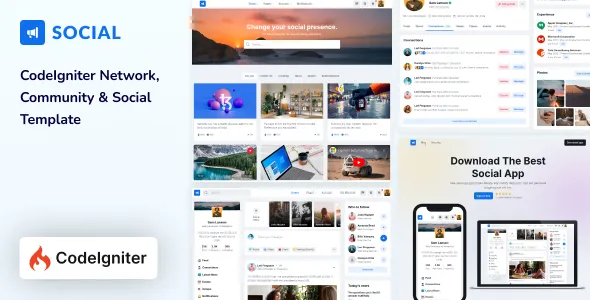
Social – CodeIgniter Network & Community Template
Social – CodeIgniter Network & Community Template is a powerful, scalable, and SEO-ready web application solution built specifically for social networking platforms, online communities, discussion portals, member-based websites, and collaborative digital ecosystems that require a robust backend framework and long-term extensibility. Developed using the CodeIgniter PHP framework, Social provides a solid server-side foundation combined with a structured frontend layout that is easy for search engines to crawl, understand, and index while remaining intuitive and engaging for users.
Social is designed for platforms where interaction, user-generated content, and community growth are central. Community websites must handle dynamic content efficiently, maintain performance under user activity, and present information clearly to both users and search engines. This template balances backend control, frontend clarity, and SEO-friendly architecture, making it suitable for developers, startups, and organizations building serious community-driven platforms.
This CodeIgniter template is ideal for social networks, online communities, private member portals, discussion platforms, interest-based networks, educational communities, startup forums, and collaboration-focused web applications.
Overview
Social is a complete CodeIgniter-based network and community template created to help developers and businesses launch fully functional community platforms without starting from scratch. It includes a well-structured backend, reusable UI components, and community-focused layouts that work together to form a cohesive, scalable application.
Each page and module follows a logical hierarchy with clear routing, structured content blocks, and consistent data flow. This organization is critical for SEO in dynamic websites, as it helps search engines understand page relationships, user paths, and content relevance even when data is generated dynamically.
Social is fully responsive and optimized for all devices, ensuring consistent performance and usability across desktops, tablets, and mobile devices.
CodeIgniter Framework Advantage
At the core of Social is the CodeIgniter PHP framework, known for its lightweight footprint, speed, and developer-friendly architecture. CodeIgniter enables efficient routing, MVC separation, and secure server-side logic, making it ideal for community platforms that require scalability and control.
The framework allows developers to manage dynamic URLs, user profiles, posts, comments, and interactions in a structured way. This server-side control is essential for building SEO-friendly dynamic pages, handling large user bases, and implementing advanced features such as role-based access and moderation systems.
Design Philosophy and Community-Centered Interface
The design philosophy behind Social focuses on clarity, usability, and engagement. Community platforms must encourage interaction while remaining easy to navigate, and Social reflects this through clean layouts, balanced spacing, and intuitive UI patterns.
Rather than overwhelming users with cluttered feeds, the interface emphasizes readability and content hierarchy. Visual separation is achieved through layout structure and spacing instead of divider lines, keeping the design modern, accessible, and SEO-friendly.
Colors, typography, and UI elements can be customized easily, allowing platform owners to align the interface with their brand or niche community identity.
Homepage and Activity Feed Structure
The homepage in Social is designed to act as the central hub of community activity. It typically features an activity feed that displays posts, updates, discussions, or shared content in a structured and readable format.
The feed layout is optimized for engagement, allowing users to consume content quickly while encouraging interaction such as comments, likes, or replies. From an SEO perspective, the structured feed ensures that content is rendered in a crawlable format, especially when combined with proper pagination or dynamic loading strategies.
Clear navigation paths guide users to profiles, groups, discussions, and content categories.
User Profiles and Member Pages
Social includes dedicated layouts and backend logic for user profiles and member pages. These sections allow users to create personalized profiles, share information, post content, and interact with others.
Each profile page is structured with clean URLs, organized sections, and readable content blocks. This structure supports SEO by allowing search engines to index public profiles, community contributions, and user-generated content where appropriate.
Profile pages also help build long-term content depth, which is valuable for organic visibility in large communities.
Community Groups and Interest-Based Spaces
Social is well-suited for group-based communities. Dedicated sections allow users to create or join groups based on interests, topics, projects, or organizations.
Group pages provide structured layouts for discussions, updates, and shared resources. This segmentation improves user experience and supports SEO by creating topic-focused content clusters that search engines can associate with specific keywords and themes.
Well-organized group content also encourages deeper engagement and repeat visits.
Posts, Discussions, and User-Generated Content
User-generated content is the foundation of any community platform, and Social is designed to handle it efficiently. Posts, discussions, and comments are displayed using structured layouts that maintain readability and performance.
Each content item can be routed with unique URLs, making it easier for search engines to crawl and index valuable discussions. This is especially important for forums, Q&A communities, and knowledge-sharing platforms.
Clear content hierarchy ensures that long discussion threads remain accessible and organized.
Messaging and Interaction Features
Social supports private and public interaction models through messaging and engagement features. These systems can be extended to support direct messages, notifications, and activity alerts.
While private content remains inaccessible to search engines, public interaction signals such as comments and replies contribute to site freshness and user engagement metrics, indirectly supporting SEO performance.
Moderation, Roles, and Community Control
Social is designed with moderation and role management in mind. The CodeIgniter backend allows developers to implement user roles, permissions, and content moderation workflows.
This is essential for maintaining content quality, community standards, and platform trust. A well-moderated platform also improves SEO by reducing spam, duplicate content, and low-quality pages.
Clear separation between public and private content ensures better crawl efficiency.
Performance Optimization and Scalability
Social is built for performance and scalability. The CodeIgniter framework allows efficient database handling, caching strategies, and optimized server-side processing.
As community activity grows, the platform can be scaled horizontally or vertically depending on hosting setup. Clean backend architecture ensures that performance remains stable even with increasing user-generated content.
Fast load times and efficient rendering are essential for both user experience and search engine rankings.
One of Social’s strongest advantages is its SEO-friendly dynamic structure. Clean URLs, proper routing, and MVC-based rendering allow search engines to crawl dynamic pages effectively.
Developers can implement custom meta tags, schema markup, canonical URLs, and pagination controls directly at the server level. This level of control is critical for large community platforms where content volume grows rapidly.
Social supports long-term SEO strategies such as content categorization, internal linking, and topic clustering.
Security and Data Handling
As a CodeIgniter-based application, Social supports secure development practices including input validation, session handling, CSRF protection, and authentication systems.
These security measures are essential for community platforms that manage user accounts, personal data, and private interactions. A secure platform also builds user trust and protects long-term brand reputation.
Custom Development and Extensibility
Social is designed for developers who need flexibility. The CodeIgniter structure allows easy extension with new modules, APIs, admin dashboards, and third-party integrations.
This makes the template suitable for startups building MVPs as well as organizations planning long-term community platforms. Features such as notifications, gamification, subscriptions, or monetization can be added without restructuring the core system.
The clean codebase supports maintainability and future expansion.
Admin Panel and Platform Management
Social supports the development of admin-level controls for managing users, content, reports, and platform settings. Administrative tools are essential for monitoring activity, resolving issues, and guiding community growth.
Backend management capabilities help ensure smooth operation and content quality, which indirectly supports SEO through improved site health.
Use Cases and Target Audience
Social is ideal for social networking startups, online communities, discussion platforms, educational forums, internal company networks, membership-based websites, and collaboration tools.
It is also suitable for developers and agencies building custom community solutions for clients using CodeIgniter.
Social is designed to support continuous content growth. User-generated posts, discussions, and profiles naturally expand the site’s content footprint over time.
When structured correctly, this growth improves organic visibility and topical authority. Internal linking between profiles, groups, and discussions strengthens site architecture and crawl depth.
This makes Social a strong foundation for long-term SEO-driven community platforms.
Why Choose Social
Social stands out because it combines the flexibility of CodeIgniter with a community-focused design and SEO-ready architecture. It is not just a frontend template but a backend-capable foundation for real social and community platforms.
The emphasis on scalability, performance, customization, and SEO control makes Social suitable for serious, growth-oriented projects.
Social allows developers and organizations to focus on building meaningful communities while relying on a reliable and extensible technical foundation.
Feature Highlights
-
Built on the CodeIgniter PHP framework
-
Community and social network-focused architecture
-
Fully responsive across all devices
-
Structured user profiles, groups, and content layouts
-
SEO-friendly dynamic routing and URLs
-
Performance-optimized backend structure
-
Secure authentication and data handling
-
Developer-friendly and extensible codebase
-
Scalable foundation for growing communities
Who Should Use Social
Social is perfect for developers, startups, and organizations that want to build a professional, scalable, and search-engine-friendly social or community platform using CodeIgniter. It suits forums, niche networks, membership portals, and collaboration-focused websites.
It is also ideal for agencies delivering custom community solutions to clients.
Conclusion
Social – CodeIgniter Network & Community Template is a complete and future-ready solution for building scalable, SEO-friendly, and performance-optimized community platforms. It combines a powerful CodeIgniter backend, structured content flow, and developer-level flexibility to support both user engagement and search engine visibility.
With its clean architecture, extensible design, and community-first approach, Social provides everything needed to build a reliable, engaging, and long-lasting network or community website.